Accelerating Dictionary Encoding Based Compression on GPU
Introduction
This post is a short introduction to my course project in CMPT 984 (a graduate course on GPU) at Simon Fraser University: accelerating a dictionary encoding based compression algorithm with CUDA, together with an ablation study and kernel-level profiling. The full details can be found in the project report and the presentation slides.
Why GPU + compression? GPU enjoys massive parallelism (SIMT architecture) and an order-of-magnitude higher memory bandwidth than CPU, while the PCIe bus between host and device remains a narrow pipe. Data compression fits this picture nicely:
- many compression algorithms can be decomposed into independent per-chunk work, which is exactly what GPU is good at;
- moving compressed data across PCIe indirectly saturates the limited bus bandwidth with more useful payload.
The Benchmark Algorithm
To keep the focus on GPU optimization itself, a simple dictionary encoding algorithm is used as the benchmark: 16 frequently shown characters (vowels, space, etc.) are preselected into a dictionary, so each of them can be encoded with 4 bits plus 1 flag bit (5 bits in total), while any other character costs 9 bits. The compression pipeline is:
- Load the lookup dictionary and copy input data from host to device;
- Divide the input stream into chunks (1024 characters each), one GPU thread encodes one chunk;
- Compute the offset of each encoded chunk in the output byte stream (encoded chunks vary in size);
- Assemble encoded chunks into the output buffer according to the offsets, and copy it back to host.
Three GPU Optimizations
The project studies three features adopted on the GPU side.
Lookup Dictionary (LD)
The character-to-bits mapping never changes during runtime, so it is loaded into the constant memory on device, which is cached and shared by all threads. Each lookup costs O(1), instead of looping over a list to test membership.
Memory Coalesced Access (MCA)
With the naive horizontal partitioning, each thread reads a consecutive range of characters, so addresses accessed by threads within the same warp at each step are scattered and cannot be coalesced:
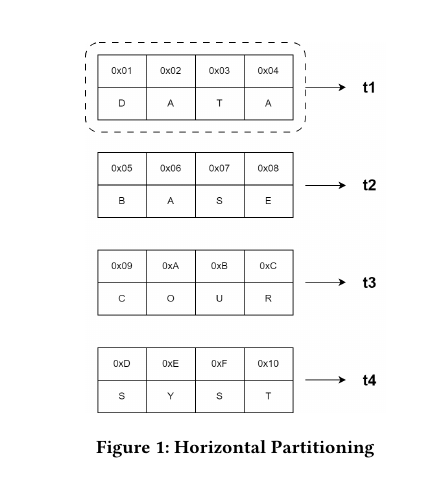 Horizontal partitioning: consecutive addresses per thread, scattered across the warp
A vertical (columnar) partitioning makes threads in a warp touch adjacent addresses simultaneously, so the hardware can combine them into one coalesced memory transaction:
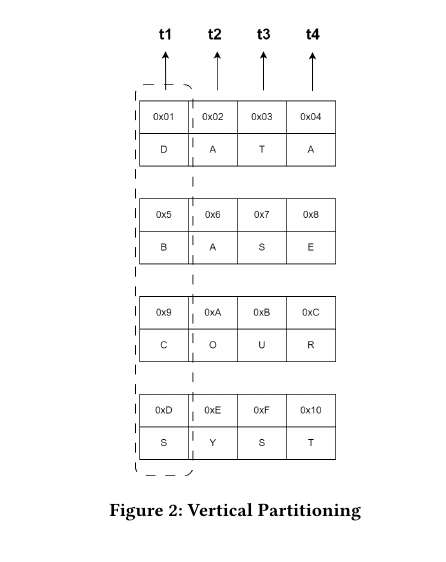 Vertical partitioning: adjacent addresses across the warp at each step
Parallelized Assembly (PA)
After per-chunk encoding, the variable-length chunks must be stitched into one byte stream. Once the offset of every chunk is known, the total buffer size can be allocated immediately, and each thread independently writes its own chunk to its destination offset — the assembly becomes embarrassingly parallel:
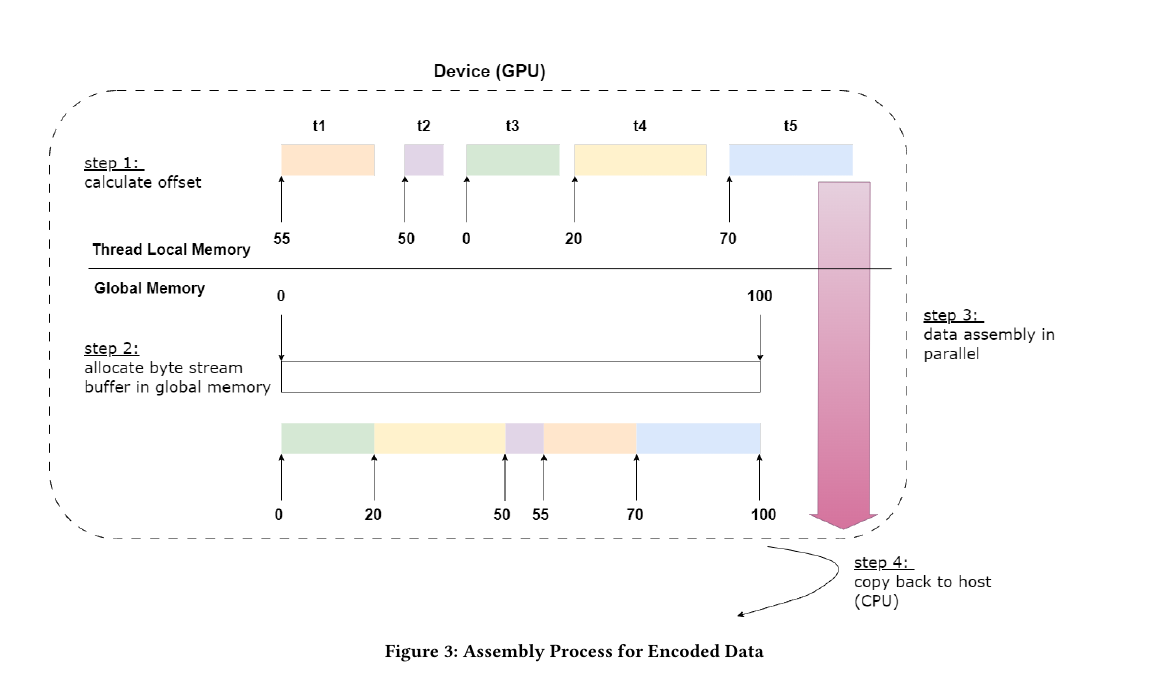 The 4-step assembly process: compute offsets, allocate the byte stream buffer, assemble in parallel, copy back to host
Evaluation
The workload is the Wikipedia top-1000 most-viewed articles concatenated into one ~28 MB text file, running on a Nvidia GPU from free-tier Google Colab.
Compression effectiveness. CPU and GPU implementations achieve identical space saving (as expected — it only depends on the algorithm logic), around 28% on average, thanks to the highly skewed character distribution in natural language:
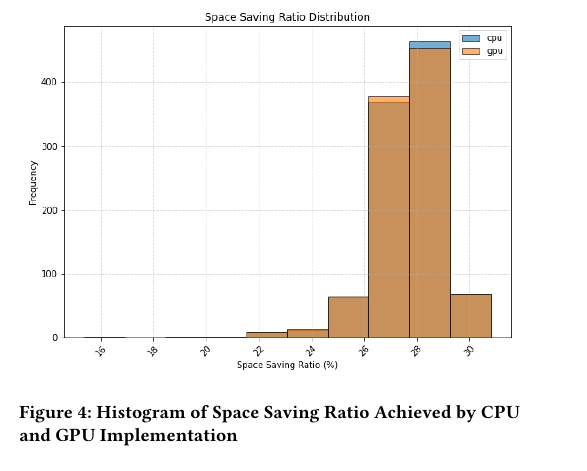 Space saving ratio distribution achieved by CPU and GPU implementations
Latency & ablation study. The end-to-end latency breakdown (unit: ms):
| Stages | All ON | OFF: LD | OFF: LD&PA | CPU |
|---|---|---|---|---|
| Character Replacement | 92 | 132 | 132 | - |
| Assemble Data | 9 | 9 | 370 | - |
| Compression Latency | 157 | 191 | 552 | 816 |
| Decompression Latency | 118 | 117 | 117 | 586 |
Key observations:
- GPU beats CPU by ~5x on compression and on decompression;
- Disabling Lookup Dictionary increases the encoding kernel latency from 92 ms to 132 ms;
- Disabling Parallel Assembly is disastrous — assembly falls back to serialized execution and slows down by 40x (9 ms → 370 ms);
- MCA did not show measurable gain in this experiment, possibly because the chunk size / block size hyperparametres make the stride too big to trigger coalescing.
Profiling with Nvidia Nsight Compute confirms what LD brings to the encoding kernel: 23% faster execution, 35% better memory throughput and 24% fewer elapsed cycles.
Takeaways
- Dictionary encoding (bit-packing) is a concise yet effective compression scheme for text;
- The dominant win on GPU comes from keeping every stage parallel — one serialized stage (like naive assembly) immediately eats up the gains;
- Vendor profiling tools (Nsight Compute/System) are essential to verify whether an “optimization” actually lands on the micro-architecture level.
Future directions include tuning block/chunk sizes, exploiting shared memory to reduce DRAM traffic, and combining with technologies like GPUDirect Storage to serve real query processing scenarios.